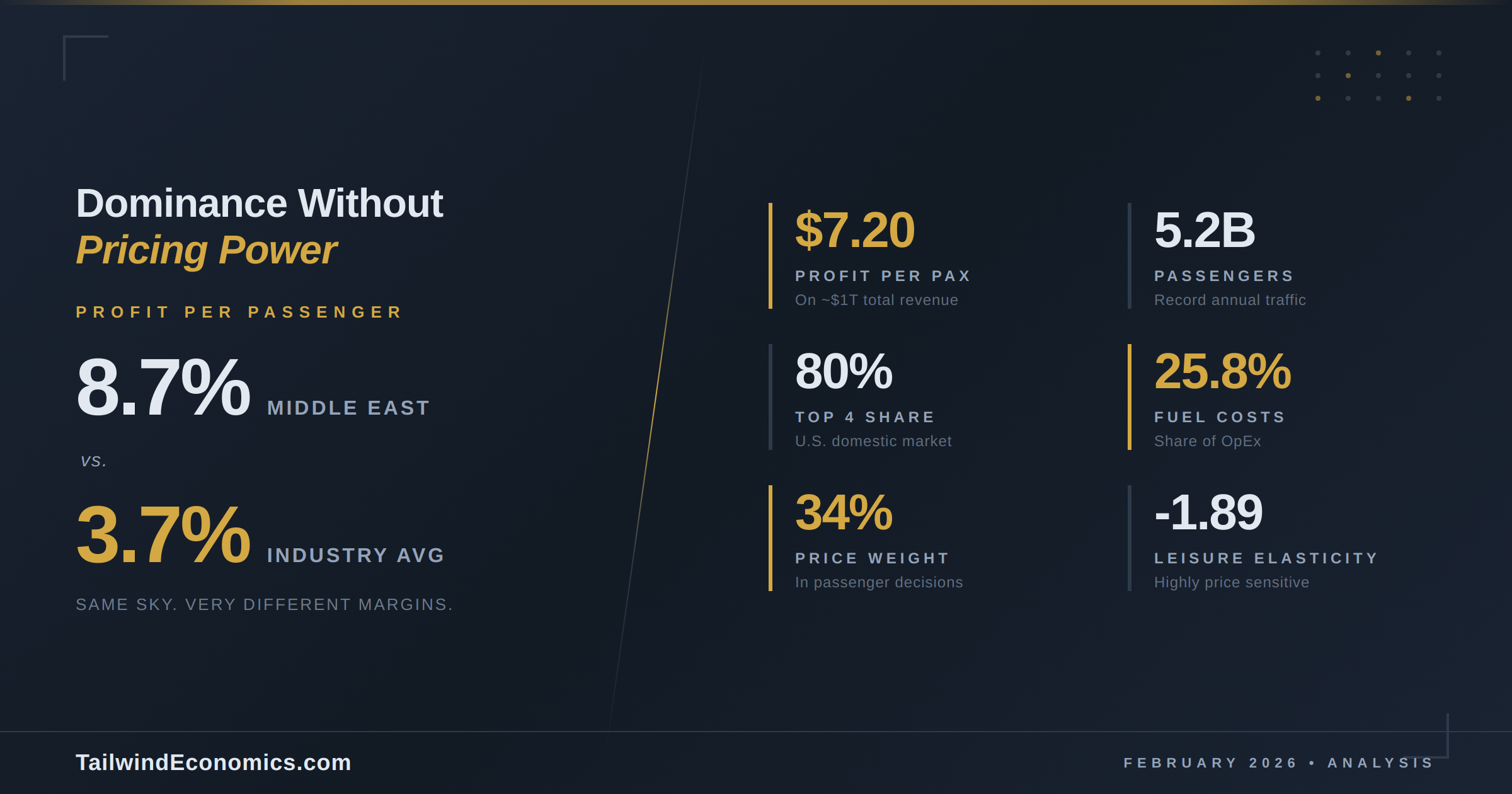
The global airline industry presents a striking economic paradox: despite generating nearly $1 trillion in revenue and carrying 5.2 billion passengers annually, airlines struggle to earn more than $7.20 profit per passenger. This razor-thin 3.7% margin exemplifies how commoditization can trap an entire industry in a cycle of price competition, even as demand soars to record levels. The fundamental challenge facing airlines today isn't operational—it's economic: how to differentiate services that consumers increasingly view as interchangeable.
This commoditization trap reveals deeper truths about market dynamics in the modern economy. Airlines invested billions in infrastructure, technology, and service improvements, yet find themselves competing primarily on price against rivals offering nearly identical core products. Understanding why airlines struggle with differentiation—and how some might escape this predicament—offers valuable insights for any industry facing similar commoditization pressures.
The economics of sameness
Economic theory provides a clear framework for understanding the industry's differentiation challenges. Lancaster's characteristics theory explains that consumers purchase transportation characteristics—speed, safety, schedule convenience—rather than airline services per se. Since these core characteristics have become standardized across competitors due to regulatory requirements and technological parity, airlines struggle to create meaningful product differences.
The industry exhibits classic oligopolistic behavior with the top four U.S. carriers controlling 80% of the domestic market, yet operates with profit margins resembling perfect competition. This apparent contradiction stems from what economists call "contestable markets"—while barriers to entry remain high, the threat of new competition and route-specific rivalry drives prices toward commodity levels.
Porter's Five Forces analysis reveals why sustainable differentiation remains elusive. Competitive rivalry is intense due to high fixed costs and low switching costs for consumers. Supplier power is concentrated among aircraft manufacturers (Boeing-Airbus duopoly) and volatile fuel markets. Most critically, buyer power has surged with price transparency tools that make airline services appear virtually identical, reducing customer choice to spreadsheet comparisons of price and schedule.
The financial data confirms this commoditization. Fuel costs represent 25.8% of operating expenses, labor another 26%, leaving little room for service differentiation investments. When Middle East carriers achieve 8.7% margins while African airlines earn just 1.3%, the difference reflects operational efficiency and market positioning rather than sustainable competitive advantages.
When differentiation strategies fail
Case studies reveal why even sophisticated differentiation attempts often falter. Pan American World Airways, once America's flagship international carrier, provides a cautionary tale of strategic misalignment. Protected by bilateral aviation agreements pre-deregulation, Pan Am possessed valuable international routes but lacked domestic feed networks. When deregulation eliminated these protected positions in 1978, competitors like United gained international access while maintaining extensive domestic operations that Pan Am couldn't replicate.
Pan Am's $1.1 billion acquisition of National Airlines represented a classic differentiation misstep—overpaying for assets that didn't align with operational capabilities. The carrier's premium international positioning became worthless when competitors offered similar routes with superior domestic connectivity. External shocks like the Lockerbie bombing and Gulf War exposed the fragility of differentiation strategies built on regulatory protection rather than operational excellence.
Even recent attempts struggle with commoditization pressures. Virgin America invested heavily in technology innovation and premium economy positioning, featuring seat-to-seat ordering systems and contemporary cabin designs. Despite these investments, the carrier couldn't achieve sustainable profitability when competing on high-traffic routes against established competitors offering lie-flat business class products. Virgin America's acquisition by Alaska Airlines in 2016 demonstrated that innovation alone cannot overcome structural cost disadvantages in commoditized markets.
The pattern is clear: differentiation attempts fail when they don't align with fundamental economic realities or when competitive responses quickly eliminate any advantage.
The consumer behavior complexity
Consumer research reveals that airline choice involves more nuance than pure price competition suggests. While price carries 34% relative weight in passenger decisions, factors like baggage allowance (16%), seat selection (10%), and booking ease (20%) play significant roles. This suggests opportunities for meaningful differentiation beyond simple cost competition.
Yet the data also reveals why differentiation remains challenging. Passengers employ "conjunctive decision rules"—airlines must meet minimum standards across multiple criteria before price becomes the deciding factor. This creates what economists call "threshold effects" where service improvements below consumer perception thresholds generate no competitive advantage.
Price elasticity varies dramatically by segment: business travelers show limited sensitivity (elasticity near -0.375) while leisure travelers demonstrate high sensitivity (-1.89). However, the business segment represents a shrinking portion of total traffic, forcing airlines to compete increasingly for price-sensitive leisure travelers.
Post-pandemic shifts have complicated differentiation strategies further. Legacy carriers are regaining ground against low-cost competitors, not through service improvements but by matching LCC pricing with basic economy fares while maintaining premium offerings for high-value segments. This "dual-track strategy" suggests successful differentiation requires sophisticated market segmentation rather than broad service positioning.
Technology enabled differentiation
Emerging trends point toward more sophisticated approaches to overcoming commoditization. Artificial intelligence-powered personalization enables what McKinsey terms "segment of one" marketing—customizing offers in real-time based on individual passenger behavior rather than broad demographic categories.
Airlines are investing in predictive analytics for operational reliability, recognizing that on-time performance correlates directly with pricing power. Singapore Airlines exemplifies this approach, achieving premium pricing through operational excellence rather than service amenities alone. Their "dual strategy" combines cost efficiency with service differentiation, proving sustainable competitive advantage requires both operational and customer-facing excellence.
Sustainability initiatives represent perhaps the most promising differentiation frontier. While sustainable aviation fuel currently represents less than 1% of global jet fuel consumption, early adopters may achieve "green premium" positioning as environmental regulations tighten. Lufthansa Group's comprehensive ESG framework and Airbus's science-based emission reduction targets suggest sustainability could provide the authentic differentiation that traditional service improvements cannot.
Ancillary revenue optimization through AI-powered merchandising offers another escape route from commoditization. Some airlines already generate over 50% of revenue from ancillaries, suggesting business model innovation may prove more effective than traditional product differentiation.
Strategic imperatives for competing beyond price
The path forward requires acknowledging that commoditization is not inevitable fate but strategic choice. Airlines that escape the commodity trap share three characteristics: operational excellence as foundation, authentic differentiation aligned with customer values, and business model innovation that creates new value propositions.
Singapore Airlines' 48-year consistency with the Singapore Girl campaign demonstrates that sustainable differentiation requires long-term brand building rather than tactical service improvements. Southwest Airlines' cultural differentiation proves that operational simplicity combined with authentic brand personality can command premium pricing even in commodity markets.
The future belongs to airlines that can combine technology-enabled personalization with operational reliability, creating customer experiences that justify premium pricing. This requires "bionic organization" capabilities—seamlessly integrating human expertise with artificial intelligence to deliver consistent, personalized service at scale.
Regulatory trends toward sustainability mandates create both challenges and opportunities. Airlines that proactively invest in environmental technologies and achieve authentic carbon reduction will likely command pricing premiums as consumer and corporate environmental consciousness grows.
Breaking the commodity curse
The airline industry's commoditization challenge reflects broader economic forces affecting many sectors: technological standardization, price transparency, and global competition. Yet the industry also demonstrates that escape remains possible through strategic innovation rather than tactical maneuvering.
Success requires abandoning the false choice between cost leadership and differentiation. The most successful airlines achieve both simultaneously through operational excellence that enables reliability premiums while investing in authentic, sustainable differentiation strategies. As airlines generate record revenues approaching $1 trillion annually, the industry's thin margins represent opportunity rather than constraint—for carriers willing to reimagine competition beyond the commodity trap.