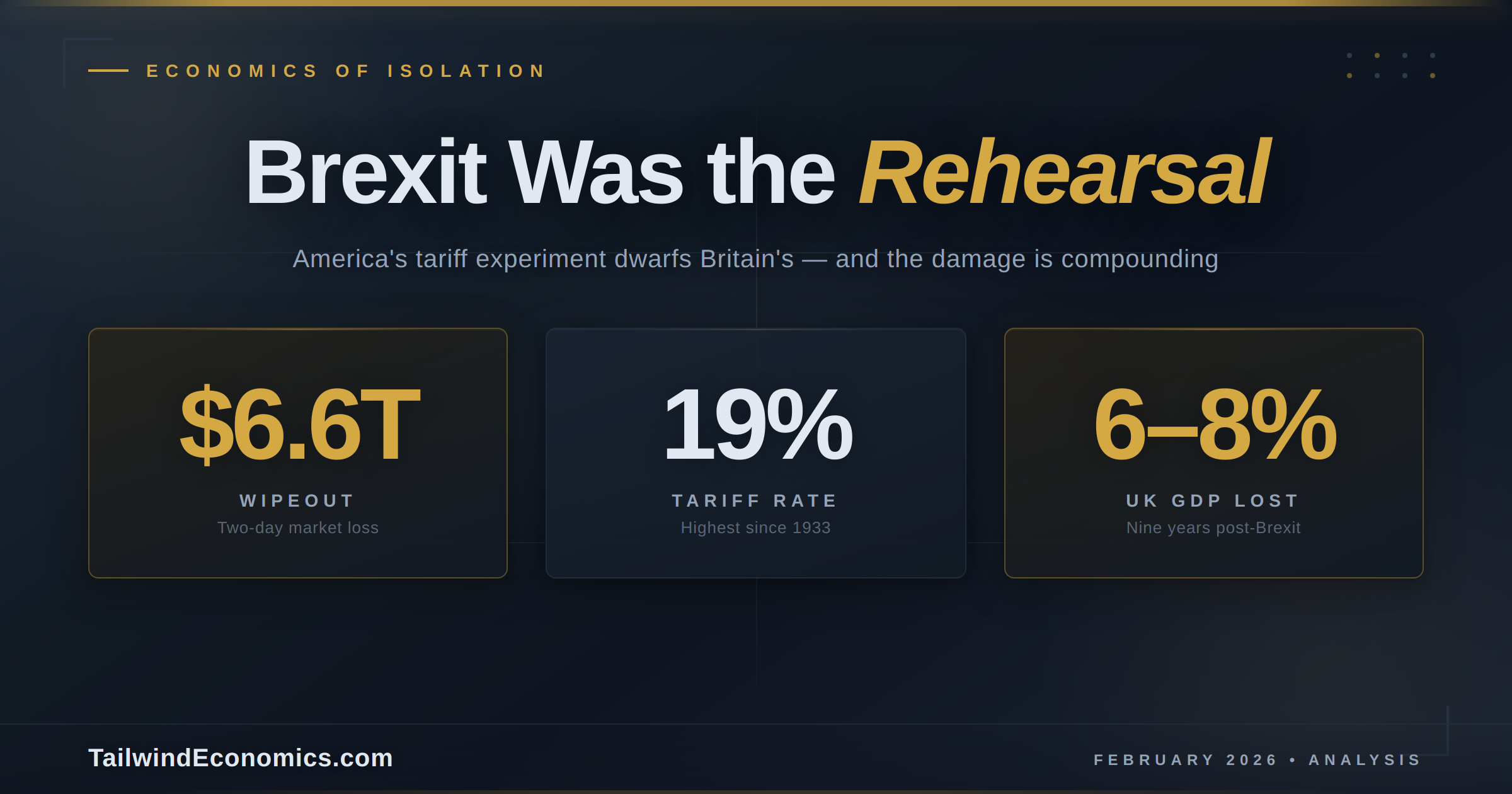
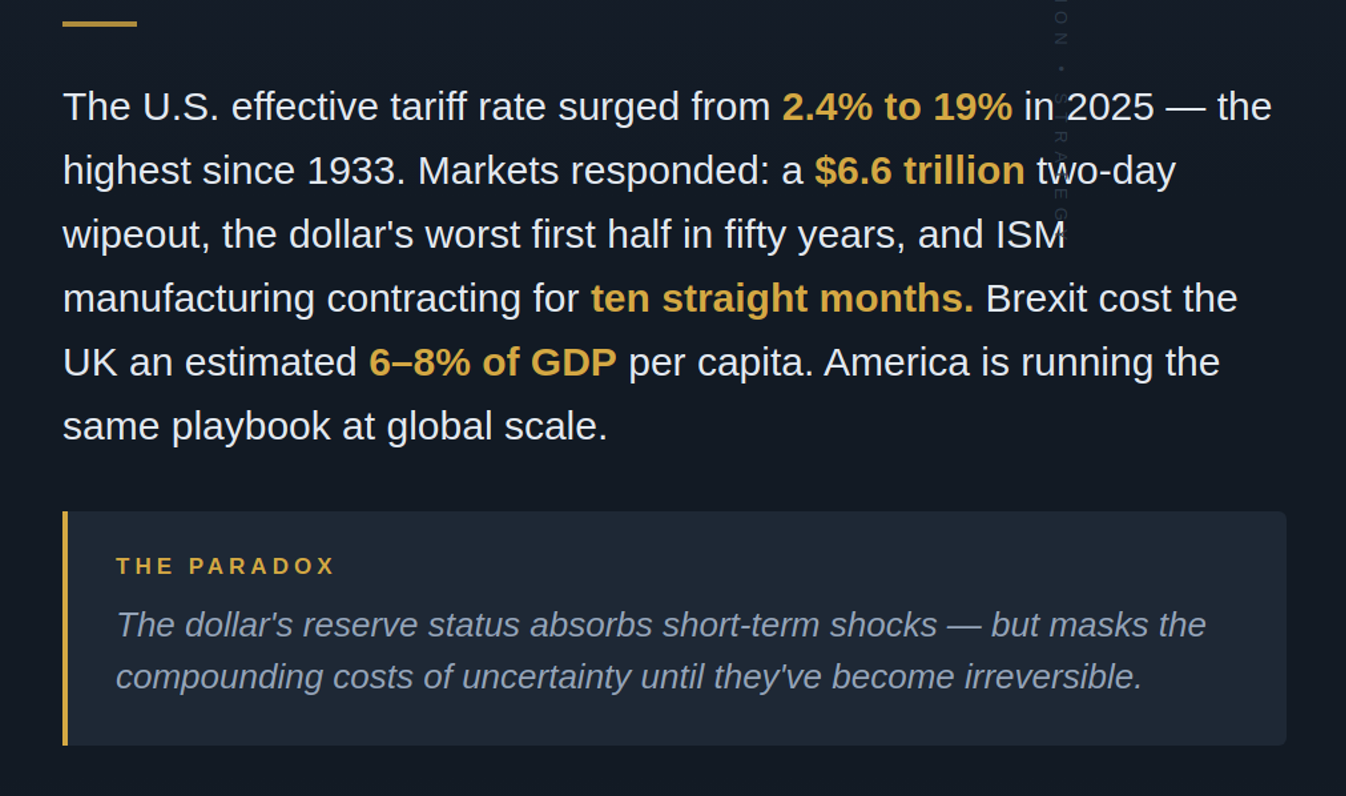
The United States is running the most aggressive trade experiment since Smoot-Hawley — and Britain's post-Brexit economic record offers a sobering preview of what comes next. In 2025, the average effective U.S. tariff rate surged from 2.4% to nearly 19%, the highest level since 1933, while stock markets shed $6.6 trillion in two days and the dollar posted its worst first-half performance in over fifty years. The parallel to Brexit is no longer speculative. A January 2026 Federal Reserve research note explicitly drew the comparison, warning that the U.S. Trade Policy Uncertainty Index had surpassed all prior records — including the peaks during Brexit itself. The critical question is whether the world's largest economy will follow Britain's trajectory of gradual, compounding decline, or whether the dollar's structural privileges can bend the curve.
What nine years of Brexit data actually show
The empirical record on Brexit is now robust enough to move beyond conjecture. The most comprehensive academic study to date — Bloom, Bunn, Mizen, Smietanka, and Thwaites, published as an NBER working paper in 2025 — estimates that Brexit reduced UK GDP per capita by 6 to 8 percent by 2025, with business investment running 12 to 18 percent below comparable economies. The Office for Budget Responsibility holds its central estimate at a 4 percent long-run productivity loss, while the Centre for European Reform pegs the gap at roughly 5 percent. What matters most is the trajectory: the pre-referendum consensus forecast of a 4 percent GDP loss proved roughly accurate at the five-year mark but significantly underestimated longer-run damage. Costs did not arrive as a single shock. They accumulated.
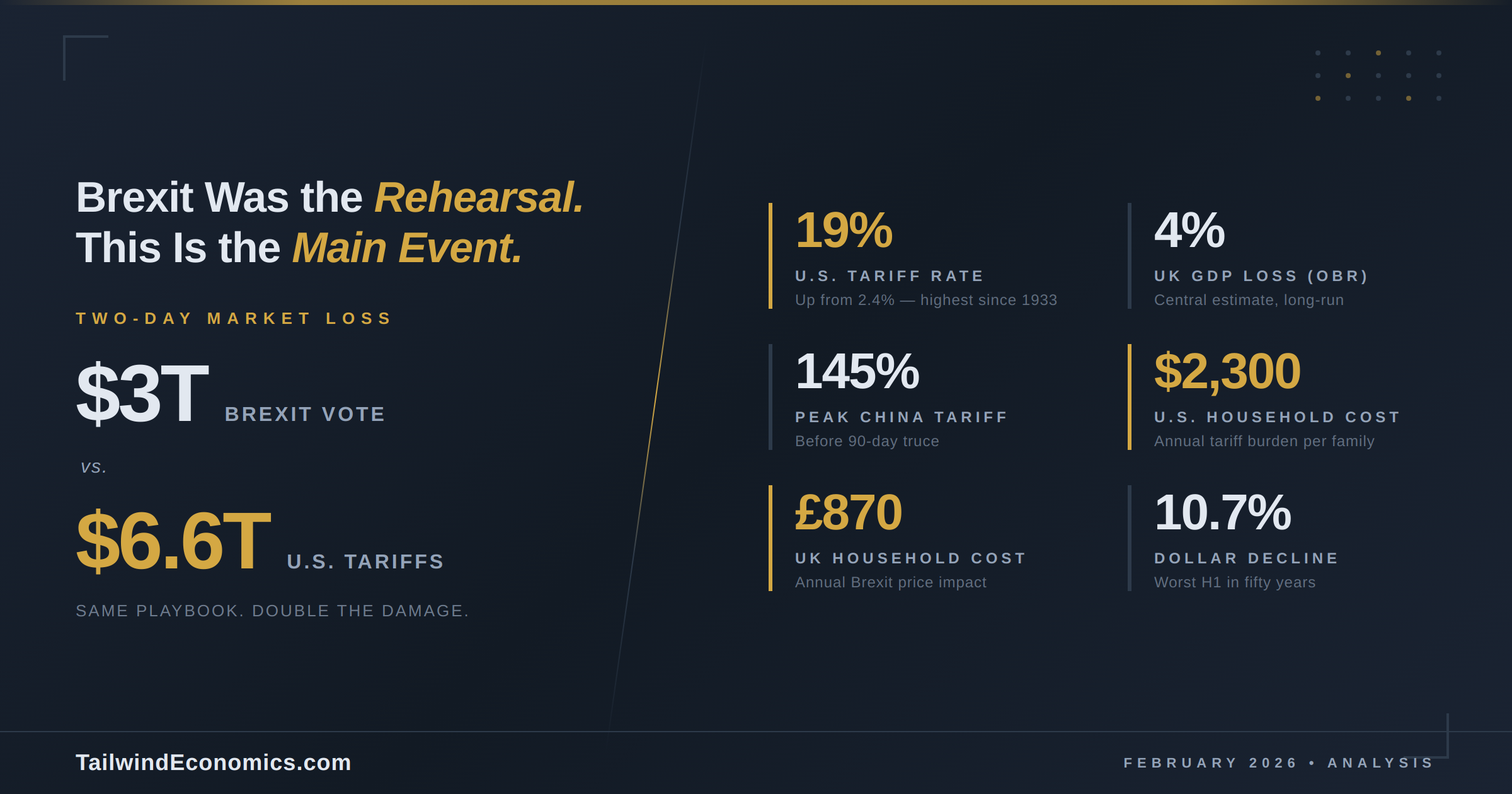
The channels of damage were diffuse and self-reinforcing. UK trade intensity — exports plus imports as a share of GDP — fell 1.7 percentage points below its pre-pandemic level by late 2023, while the rest of the G7 rose 1.7 points above. Over 440 financial services firms relocated operations from London to EU cities, moving approximately £900 billion in bank assets — roughly 10 percent of the entire UK banking system. Sterling dropped 12 percent on referendum night and remains about 10 percent below pre-vote levels a decade later, imposing an estimated £870 per year in higher living costs on the average household through import price pass-through. UK real GDP per capita grew just 4.4 percent between 2016 and 2024. Italy's grew 11 percent.
The mechanism Douglass North would have predicted proved decisive: the transaction costs of rewriting trade rules dwarfed the direct effects of any single barrier. Rules-of-origin paperwork, sanitary inspections, and regulatory divergence destroyed over 40 percent of product varieties exported to the EU in the first fifteen months of the Trade and Cooperation Agreement. These are not tariffs. They are the institutional friction costs of deglobalization — and they compound.
America's tariff experiment dwarfs Brexit in scale
The 2025 U.S. tariff regime makes Brexit look cautious by comparison. The "Liberation Day" executive order of April 2, 2025, imposed a 10 percent baseline tariff on nearly all imports, with country-specific rates reaching 46 percent on Vietnam, 34 percent on China (later escalating to 145 percent before a truce), and 20 percent on the EU. Section 232 tariffs hit steel and aluminum at 25 to 50 percent. Automobiles face a blanket 25 percent duty. The administration simultaneously suspended WTO budget contributions, blocked appellate body appointments, and signaled that the most-favored-nation principle itself was negotiable.
Markets delivered an unambiguous verdict. The S&P 500 fell 10.5 percent in the two sessions following Liberation Day — the largest two-day dollar-value loss in history. The VIX spiked to 45, its highest reading since the pandemic crash. More alarmingly, the 10-year Treasury yield surged over 50 basis points in two days as hedge funds faced margin calls and speculation mounted about foreign sovereign selling. That bond market convulsion reportedly pressured the administration into announcing a 90-day tariff pause. When the bond market, not Congress, becomes the binding constraint on trade policy, something structural has shifted.
The Dollar Index fell 10.7 percent in the first half of 2025, effectively unwinding the entire structural bull cycle from 2010 to 2024. Morgan Stanley projects another 10 percent decline by end of 2026. ISM manufacturing contracted for ten consecutive months through December 2025, with the ISM chair stating plainly that "current trade policy has not boosted the manufacturing sector — in many ways, it has had the opposite effect." The Yale Budget Lab estimates tariffs raised consumer prices by 1.7 percent, costing the average household roughly $2,300 per year, with the burden falling 2.5 times more heavily on the lowest income decile.
The reserve currency is a shield, not a wall
The crucial structural difference between the U.S. and post-Brexit Britain is the dollar. Dani Rodrik's globalization trilemma posits that nations cannot simultaneously maintain deep economic integration, full national sovereignty, and democratic politics — they must sacrifice one. Brexit sacrificed integration. The U.S. is attempting the same trade-off but with a currency that underpins global finance.
Foreign holdings of U.S. Treasuries hit a record $9.13 trillion in June 2025, suggesting that dollar demand remains structurally resilient. Yet the dollar's share of global foreign exchange reserves has slid to 57.8 percent — a historic low, down from 90 percent in 1960. Harvard economist Ken Rogoff frames current policy as "an accelerant" of pre-existing diversification trends. Central banks purchased over 244 metric tons of gold in Q1 2025 alone. This is de-risking, not yet de-dollarization. But the distinction narrows with each policy shock.
The reserve currency status cuts both ways. It grants the U.S. borrowing privileges that absorb trade deficits and cushion domestic consumption — Ricardo's comparative advantage operating through capital markets rather than goods markets. But it also means that tariff-induced dollar volatility disrupts global trade invoicing, commodity pricing, and emerging-market debt servicing. When America imposes tariffs, it exports instability. When Britain did so, the world barely noticed.
Uncertainty is the real tariff
The deepest lesson from Brexit is not about trade volumes or GDP points. It is about the corrosive effect of prolonged policy uncertainty on investment. Bloom and colleagues identified four channels through which Brexit damaged the UK economy: persistent uncertainty, reduced demand, diverted management attention, and misallocation of resources away from productive, internationally exposed firms. Every one of these channels is now operating in the United States.
The Atlanta Fed found that 70 percent of executives reported facing tariff-related uncertainty in mid-2025. Over 2,000 publicly traded companies mentioned tariffs on earnings calls — the most in quarterly data going back to 2016. Capital expenditure projections for manufacturing flipped from positive 5.2 percent growth to negative 1.3 percent in five months. The gravity model of trade predicts that bilateral trade flows are proportional to economic mass and inversely proportional to friction. The U.S. has just raised friction with virtually every trading partner simultaneously.
Proponents argue this disruption is strategic — that supply chain security, manufacturing reshoring, and reduced dependence on adversaries justify short-term costs. There is evidence for selective success: semiconductor reshoring driven by TSMC's $150 billion investment is real, and tariff-motivated reshoring announcements surged 454 percent in 2025. But the Reshoring Initiative projects actual job creation falling to 174,000 in 2025, down from 244,000 the prior year, precisely because uncertainty is freezing decisions. U.S. manufacturing costs remain 10 to 50 percent higher than offshore competitors. Tariffs can redirect investment. They cannot repeal comparative advantage.
The compounding has only just begun
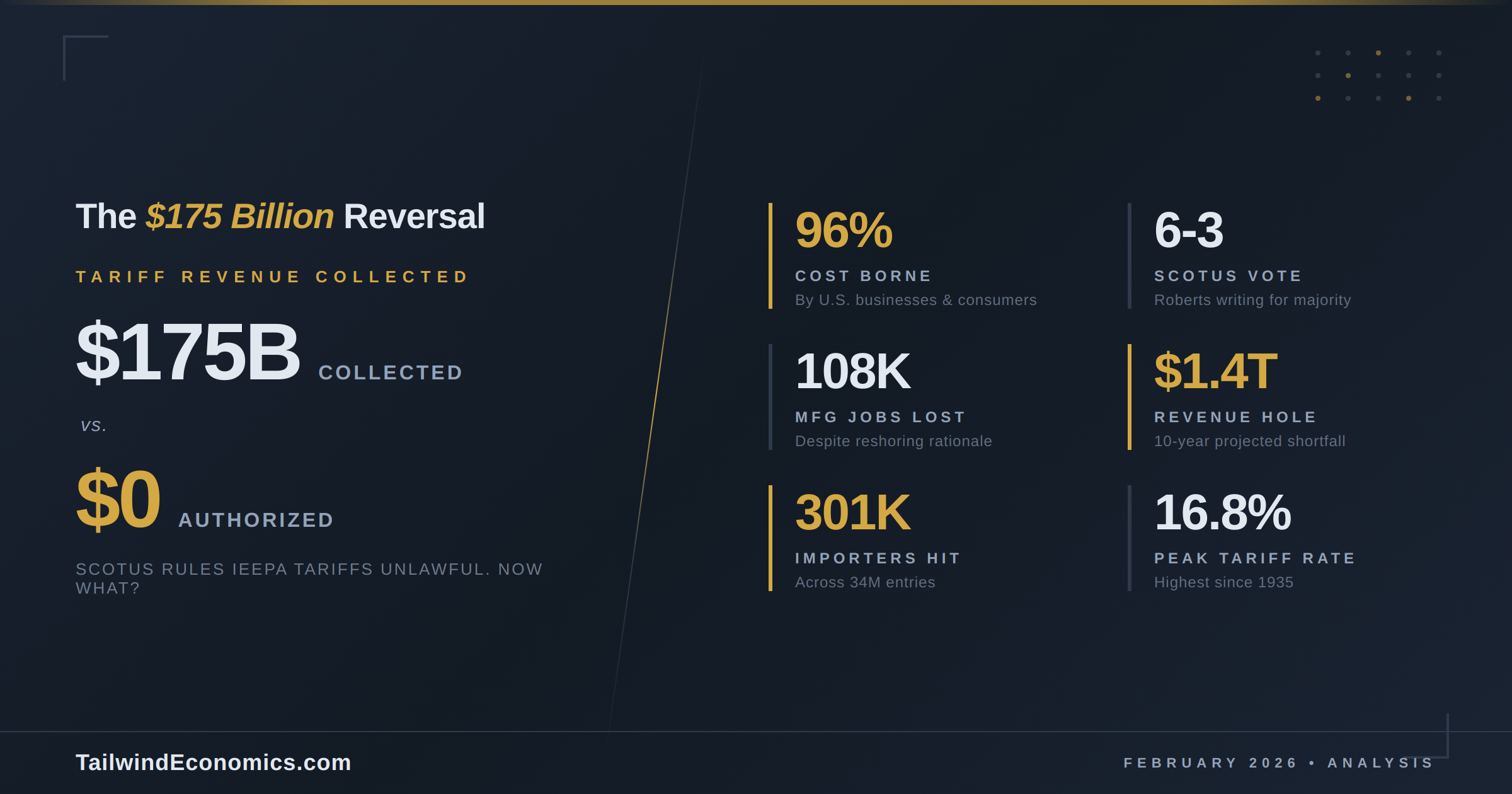
Brexit's most important warning is temporal. Initial forecasts underestimated long-run costs by roughly half. The damage was not a discrete event but a slow bleed — investment deferred year after year, trade relationships atrophied, productivity gains foregone. The February 2026 Supreme Court ruling striking down IEEPA-based tariffs adds a new layer of legal uncertainty, with the administration immediately pivoting to alternative statutory authorities. This is not resolution. It is another turn of the uncertainty ratchet.
The U.S. enters this experiment with advantages Britain never had: the world's reserve currency, the deepest capital markets, and an economy large enough to absorb shocks that would cripple smaller nations. But those advantages create a dangerous asymmetry of perception. Because the consequences arrive gradually — a few tenths of a percentage point off GDP here, a slight widening of the term premium there — they are easy to dismiss until they have compounded beyond reversal. Britain learned this. The data is unambiguous. The question is whether America is paying attention.