
Mass deportation of undocumented workers would shrink the U.S. economy by up to 7.4%, eliminate millions of native-born jobs, and raise consumer prices by as much as 9% — the economic equivalent of a self-inflicted recession larger than 2008. That is the central finding across studies from the Peterson Institute, Penn Wharton Budget Model, and the Congressional Budget Office. Far from freeing up employment for American workers, every major natural experiment in immigration enforcement — from Alabama's HB 56 to the 2025 ICE workplace raids — demonstrates that removing immigrant labor destroys the jobs that depend on it.
Three foundational economic frameworks — factor complementarity, the Keynesian multiplier, and the Solow growth model — all point to the same conclusion: immigrant and native-born workers are not interchangeable parts in a fixed machine. They are complementary gears. Remove one, and the other stops turning.
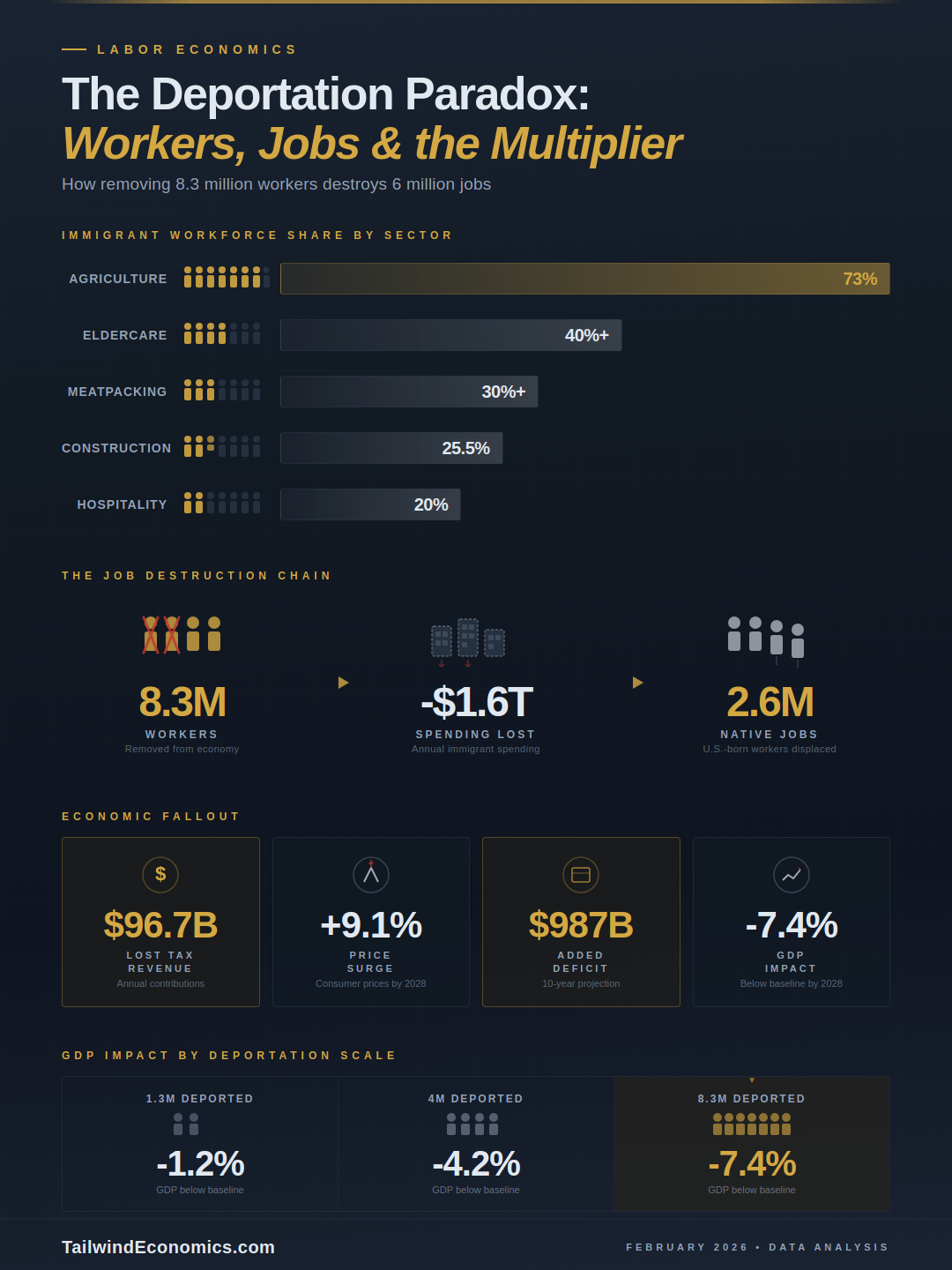
The roughly 8.3 million undocumented workers in the U.S. labor force represent just 5% of all workers, yet they are concentrated in sectors where their absence cascades through entire supply chains — agriculture, construction, meatpacking, eldercare, and hospitality. These workers pay $96.7 billion annually in federal, state, and local taxes, including $25.7 billion into Social Security they will never collect. The CBO estimates the recent immigration surge will add $8.9 trillion to GDP over the next decade while reducing federal deficits by $900 billion.
The economy runs on complementary labor, not interchangeable cogs
The intuition behind deportation-as-jobs-program rests on what economists call the lump of labor fallacy — the belief that an economy contains a fixed number of jobs, and removing one worker frees a slot for another. The formal framework that explains why this fails is factor complementarity: when two inputs to production are complements (like manual labor and supervisory labor), increasing one raises the marginal product of the other. Removing one doesn't free up value — it destroys the productivity of what remains.
UC Davis economist Giovanni Peri has spent two decades documenting this dynamic. Because immigrants disproportionately take manual, physically intensive positions — harvesting, roofing, meatpacking — native-born workers specialize in communication-intensive, supervisory, and managerial roles that pay more. Peri's 2024 NBER paper found immigration actually increased wages of less-educated native workers by 1.7% to 2.6% over 2000–2019, precisely because it pushed natives into higher-value positions. His review of 270 estimates from 27 published studies found the average wage effect on native workers is essentially zero.
This plays out through what trade economists call the Rybczynski effect: when an economy gains more of one factor of production, it expands output of goods intensive in that factor, increasing total output. Reverse the process through deportation, and the economy contracts those sectors without freed-up workers being reabsorbed elsewhere. The effect is asymmetric — expansion is smooth, but contraction produces bottlenecks and cascading failures.
On a California farm, immigrant field workers enable native-born supervisors, truck drivers, and equipment operators to have jobs. In construction, immigrant roofers create work for native-born electricians, plumbers, and project managers. In restaurants, immigrant line cooks are the reason native-born servers and managers can be employed. Remove the foundation, and the structure collapses.
David Card's landmark study of the 1980 Mariel Boatlift — when 125,000 Cuban refugees increased Miami's labor force by 7% overnight — found no discernible effect on wages or unemployment for native workers, a finding that contributed to his 2021 Nobel Prize. Harvard's George Borjas found wage declines among a narrow group: non-Hispanic male high school dropouts (roughly 8% of native workers). But even by Borjas's own models, long-run effects on average native wages converge to zero as capital adjusts — consistent with neoclassical adjustment theory. The debate is not whether deportation helps most native workers — both economists agree it does not.
Alabama tried it first, and the results were catastrophic
The most data-rich natural experiment in deportation economics occurred in Alabama. In June 2011, Governor Robert Bentley signed HB 56, dubbed the "toughest immigration law in the nation." It required police to check immigration status during any stop, mandated E-Verify for all employers, and made it a crime to transport undocumented immigrants. Sponsors called it a "jobs bill."
The University of Alabama's Center for Business and Economic Research calculated the law would shrink the state's GDP by $2.3 billion to $10.8 billion — up to 6.2% of the entire economy. An estimated 40,000 to 80,000 undocumented workers left the state, taking with them $130.3 million in annual state and local tax payments. The law was projected to destroy 70,000 to 140,000 jobs.
Agriculture was devastated immediately. Tomato farmer Chad Smith lost 80% of his crew at peak harvest. Another grower reported leaving "15,000 boxes in the field." The state's agriculture sector, worth $5.5 billion annually with one-fifth of all jobs linked to farming, entered crisis. Native workers were supposed to fill the vacancies. One who tried, Melinda Martinez, quit after a single day: "I had to go home yesterday. I couldn't handle it. It's backbreaking."
The foreign investment damage was equally severe. A German Mercedes-Benz executive was arrested during a routine traffic stop for lacking immigration papers. Foreign companies employed 77,500 workers in Alabama — 5% of the state's workforce — and the auto industry alone supported 45,000 jobs. By 2012, Alabama had the worst economy in the Southeast, ranking 47th nationally. The 11th Circuit Court of Appeals eventually struck down most of HB 56.
Georgia's parallel experiment, HB 87, produced $140 million in direct crop losses and a projected $391 million in total annual economic damage including multiplier effects. Governor Nathan Deal's proposed solution — using prison parolees to harvest fields — was dismissed by farmers. One said: "I want to be a farmer; I don't want to be a warden." Workers bypassed Georgia entirely for North Carolina, where "farmers had more labor than they knew what to do with."
The Sectors Where No Amount of Wage Increases Can Replace Immigrant Labor
The concentration of immigrant labor in specific sectors creates vulnerabilities rooted in labor market segmentation — these are secondary labor markets where the wage elasticity of native labor supply is effectively zero within any economically viable price range.
Agriculture employs a workforce that is 73% foreign-born, with roughly half undocumented. H-2A visa certifications have grown eightfold since 2005 to 384,900 positions in 2024, yet 56% of farmers still report shortages. Agricultural output would fall by $30 to $60 billion without immigrant farmworkers, and dairy prices could nearly double. The Department of Labor conceded in October 2025 that higher wages "have not resulted in a meaningful increase in new entrants of U.S. workers."
Construction reached a milestone in 2024: immigrants comprise 25.5% of the total workforce, with one in three skilled tradespeople foreign-born. Roughly 1.5 million undocumented workers fill roles where their share exceeds 30%. The industry already needs 454,000 additional workers in 2025 against a housing deficit of 3.8 million units. Removing 1.5 million construction workers would cause the average county to lose approximately a year's worth of construction over four years.
Eldercare is where inelastic demand applies most directly — aging is not optional. Over 40% of home health aides are foreign-born. Meanwhile, 12,000 Americans turn 65 every day and BLS projects over 820,000 additional home health workers will be needed in the coming decade. Removing immigrant caregivers would force family members — disproportionately women — out of the paid workforce, creating secondary opportunity cost losses that multiply beyond the care sector.
Meatpacking and hospitality show the same pattern. The 2008 Postville, Iowa raid bankrupted a plant, halved a town's population, and triggered mass foreclosures. The 880,000 undocumented workers in hospitality support 15 million total U.S. jobs, and 71% of hotels cannot fill open positions despite active recruitment.
Five sectors where the math makes deportation economically impossible
The concentration of immigrant labor in specific sectors creates vulnerabilities that no amount of native-worker recruitment can resolve.
Agriculture employs a workforce that is 73% foreign-born, with roughly half of all hired farmworkers undocumented. H-2A visa certifications have grown eightfold since 2005 to 384,900 positions in 2024, yet 56% of farmers still reported labor shortages. The sector contributes over $1 trillion to GDP when food processing and related industries are included. Agricultural output would fall by $30 to $60 billion without immigrant farmworkers, and dairy prices could nearly double.
Construction hit a historic milestone in 2024: immigrants now comprise 25.5% of the total workforce, with one in three skilled tradespeople foreign-born. Roughly 1.5 million undocumented workers fill roles where their share exceeds 30% — roofers, drywall installers, plasterers, and concrete workers. The industry already has 248,000 unfilled positions and needs 454,000 additional workers in 2025. The existing skilled labor shortage costs $10.8 billion annually in delayed projects and unbuilt homes. The U.S. faces a housing deficit of 3.8 million units; removing 1.5 million construction workers would, as one University of Utah study found, cause the average county to lose approximately a year's worth of construction over four years.
Eldercare and home health may be the sector where the math is most unforgiving. Over 40% of home health aides are foreign-born, and an estimated 114,800 undocumented immigrants work as home health and personal care aides. Meanwhile, 12,000 Americans turn 65 every day, seven in ten will need long-term care, and BLS projects over 820,000 additional home health workers will be needed in the coming decade. Nearly 60% of nursing homes already limit new patients due to staffing shortages. Harvard projects 4.6 million unfulfilled home care jobs by 2032. Removing immigrant caregivers would force family members — disproportionately women — out of the paid workforce to provide care, creating a secondary wave of economic losses.
Meatpacking and food processing has been the site of the most dramatic enforcement-to-collapse sequences. The 2008 Postville, Iowa raid — 389 workers arrested at a kosher slaughterhouse — bankrupted the plant, halved the town's population, triggered mass foreclosures, and left the city council declaring a "humanitarian and economic disaster area." When the plant reopened under new ownership, it recruited from homeless shelters, Pacific Island nations, and Somali refugee communities because native-born Americans would not do the work. The 2019 Mississippi chicken plant raids arrested 680 workers; a subsequent job fair for 250 openings drew just 30 applicants.
Hospitality depends on approximately 880,000 undocumented workers in accommodation and food services, with immigrant concentration reaching 80% in certain restaurant roles in high-tourism regions. The sector supports 15 million U.S. jobs, and 71% of hotels with open positions cannot fill them despite active recruitment.
Why U.S. Economic Growth Depends on Immigration — Not the Other Way Around
The Solow growth model identifies three inputs to long-run economic growth: capital, technology, and labor force growth. The San Francisco Federal Reserve noted a fact that reframes the entire debate: without new immigration, the U.S. working-age population would have started declining in 2012. In the Solow framework, a shrinking labor force means a shrinking economy. Immigration is not supplementing American growth — it is preventing demographic contraction.
The Brookings Institution reported in January 2026 that net migration likely turned negative in 2025 for the first time in at least 50 years. Goldman Sachs projects net immigration will collapse to 200,000 in 2026 — down 80% from the 2010s average. The sustainable pace of monthly job creation has fallen to 20,000–50,000 and could turn negative in 2026.
Chloe East and colleagues at the University of Colorado Denver found that for every 1 million unauthorized workers removed, 88,000 U.S.-born workers lost their jobs. The Economic Policy Institute projects that deporting 4 million people would eliminate nearly 6 million total jobs. The price effects compound the damage: the Peterson Institute projects prices rising 9.1% by 2028, producing textbook stagflation — simultaneous economic contraction and rising prices caused not by an oil shock, but by deliberate labor force destruction.
The Counterargument Is Real — But Narrow
The economic case for enforcement benefiting native workers illustrates the limits of partial equilibrium analysis. Borjas's strongest claim — that immigration depresses wages for native high school dropouts by 4.8% long-run — is real for approximately 8% of native workers. In partial equilibrium, the logic holds: reduce supply, raise price. But general equilibrium effects swamp the partial story.
The Penn Wharton Budget Model quantifies the trade-off precisely: authorized low-skilled workers would see wages increase 5.0% by 2034, but high-skilled wages decline 2.8%, GDP per capita falls, and federal deficits increase by $987 billion over the first decade. The policy benefits 37% of workers while harming 63%.
The fiscal cost argument fares similarly. The National Academy of Sciences found first-generation immigrants cost state and local governments $57.4 billion annually. But this confuses a current expense with a capital investment: second-generation Americans pay $1,700 more per person annually than they consume. Over a 75-year horizon, the average immigrant pays $237,000 more in taxes than they receive. The Cato Institute found immigrants generated a cumulative fiscal surplus of $14.5 trillion from 1994–2023.
What This Means for Businesses Planning Around Labor Scarcity
The deportation paradox is not a paradox at all once you apply the frameworks that describe how labor markets actually work. In an economy characterized by factor complementarity, Keynesian multiplier dynamics, and Solow-model dependence on labor force growth, removing labor does not redistribute jobs — it destroys them.
Three signals matter for business leaders now. First, audit your supply chain's immigrant labor concentration — if your vendors or subcontractors rely heavily on immigrant workers in construction, agriculture, or food processing, you are exposed to sudden capacity shocks. Second, construction labor costs are rising 4–6% annually in high-enforcement states and food service turnover costs are up 15–20% in affected regions; build these into 2027 planning assumptions. Third, with 3.8 million housing units underbuilt and 1.5 million construction workers at risk of removal, any business dependent on housing availability should assume the shortage worsens.
The empirical record is unambiguous. After every enforcement action — Postville, Alabama, the 2025 California raids — native-born workers do not fill vacated jobs, businesses cannot operate at reduced capacity, and cascading losses multiply through communities that had nothing to do with immigration policy. The economy is not a pie to be divided. It is a network, and every severed connection weakens the whole.
Frequently Asked Questions
Q: How many jobs would mass deportation eliminate in the U.S.? A: The Economic Policy Institute estimates deporting 4 million undocumented workers would eliminate nearly 6 million total jobs — approximately 3.3 million immigrant positions and 2.6 million U.S.-born positions. The losses cascade through complementary labor relationships: for every immigrant construction worker deported, roughly 0.32 native-born construction workers also lose employment.
Q: How much would food prices increase if undocumented farmworkers were deported? A: FWD.us estimates the average American family would pay approximately $2,150 more per year by 2028 under current enforcement trajectories, with weekly grocery bills rising from $165 to $195. The Peterson Institute projects overall consumer prices would rise 9.1% above baseline by 2028 under a full mass deportation scenario. Dairy prices could nearly double given the sector's near-total dependence on immigrant labor.
Q: Do undocumented immigrants pay taxes or just use public services? A: Undocumented immigrants pay an estimated $96.7 billion annually in federal, state, and local taxes, including approximately $25.7 billion into Social Security they will never collect. The Cato Institute's analysis of 1994–2023 fiscal data found immigrants generated a cumulative fiscal surplus of $14.5 trillion in real terms.
Q: What happened to Alabama's economy after its strict immigration law HB 56? A: The University of Alabama estimated the law would cost the state $2.3 billion to $10.8 billion in GDP and eliminate 70,000 to 140,000 jobs. By 2012, Alabama had the worst economy in the Southeast. Agriculture lost entire harvests, foreign manufacturers reconsidered investments, and the 11th Circuit Court eventually struck down most provisions.
Sources: Peterson Institute for International Economics (2024), Penn Wharton Budget Model (July 2025), Economic Policy Institute (July 2025), Congressional Budget Office (2024), Brookings Institution (January 2026), Institute on Taxation and Economic Policy (2024), Cato Institute (2026), U.S. Joint Economic Committee (December 2024), National Academies of Sciences (2017), Giovanni Peri, NBER Working Paper 32389 (2024), East et al., Journal of Labor Economics (2023), FWD.us (2025), UC Irvine School of Social Ecology (2025), Federal Reserve Bank of San Francisco (November 2025), NAHB/HBI Labor Market Report (October 2025), George Borjas, Center for Immigration Studies (2013), arXiv: Economic Impact of 2025 ICE Raids on California Agriculture (2025)