
With 30-year mortgage rates at a three-year low of 6.01% and national home price appreciation slowing to its weakest pace since 2011, the rent-versus-buy calculus has shifted meaningfully in the 2026 housing market. Renting remains cheaper than owning on a monthly cash-flow basis in most major metros, yet several structural forces — from new tax provisions to the behavioral power of forced savings — continue to tilt long-run wealth accumulation toward ownership. The decision hinges not on a universal answer but on your time horizon, local market conditions, and investment discipline.
This analysis draws on February 2026 data from the Federal Reserve, NAR, Freddie Mac, S&P Case-Shiller, BLS, and the Census Bureau to frame the rent vs. buy choice through the lens of opportunity cost theory, Poterba's user cost of housing, and behavioral economics.
2026 Mortgage Rates and Home Prices: Where the Market Stands
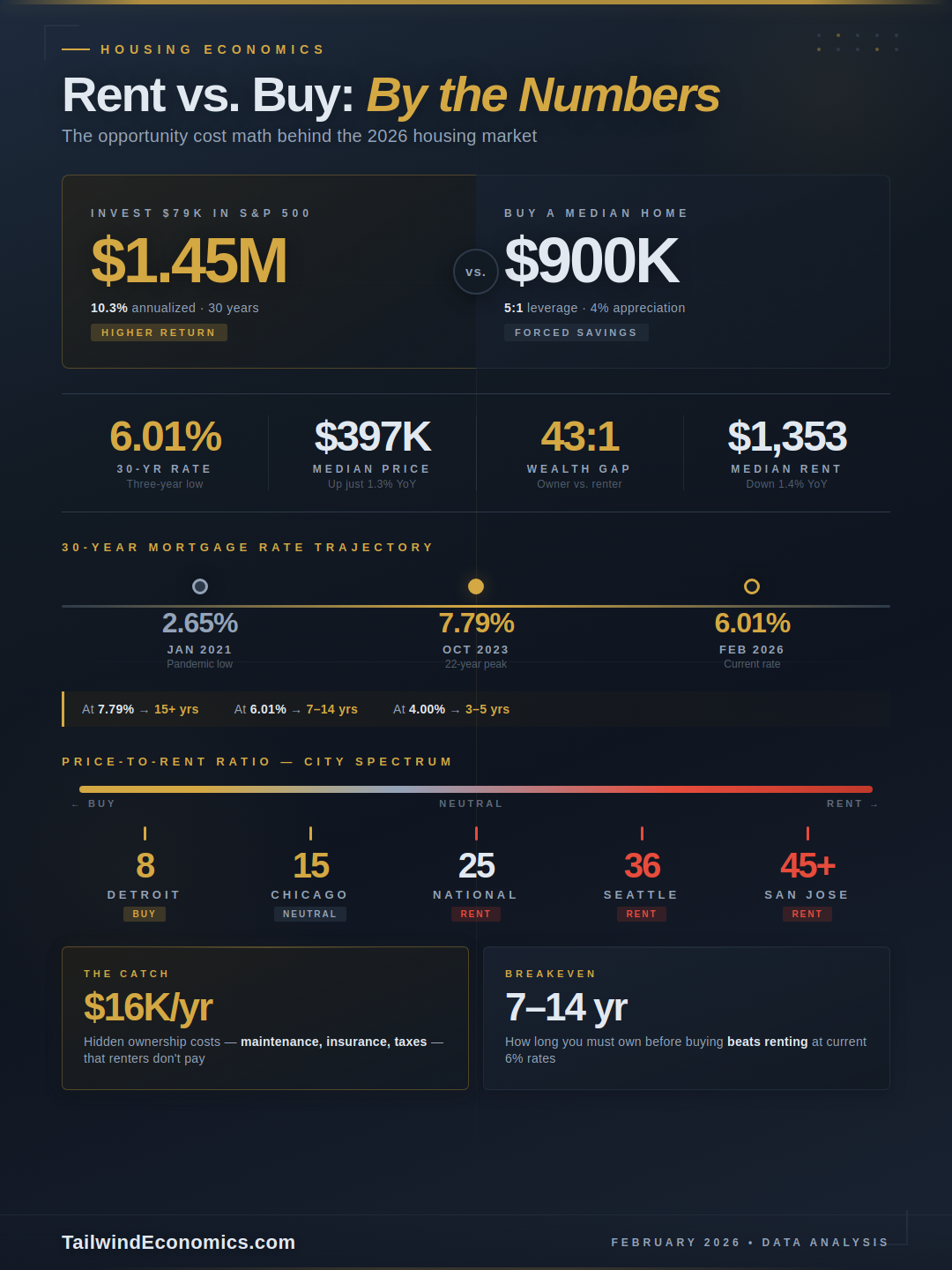
After peaking near 7.8% in late 2023, the benchmark 30-year fixed mortgage rate has declined to 6.01% as of the week ending February 19, 2026 — an 84-basis-point drop year-over-year, according to Freddie Mac's Primary Mortgage Market Survey. The 15-year fixed rate sits at 5.35%, down 69 basis points from a year ago. These are the lowest readings in more than three years, and refinance applications have more than doubled year-over-year.
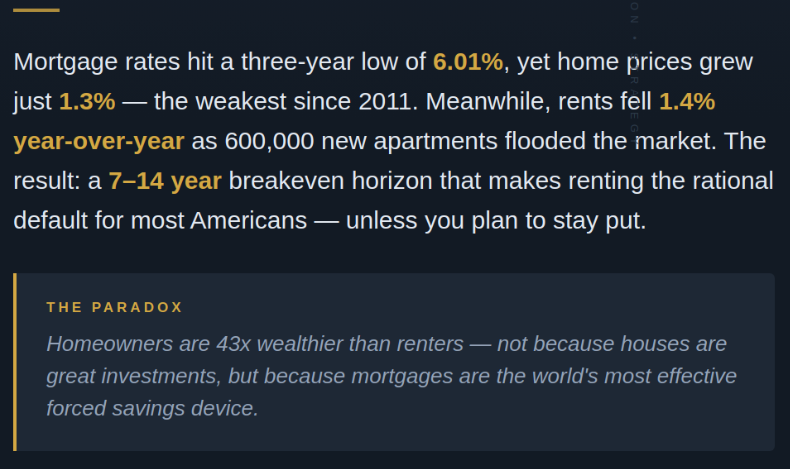
Yet lower rates have not reignited price surges. The S&P CoreLogic Case-Shiller National Home Price Index posted a full-year 2025 gain of just 1.3% — the weakest calendar-year appreciation since 2011 and 5.3 percentage points below the decade's annual average of 6.6%. NAR's January 2026 median existing-home price of $396,800 reflects seasonal softness, but the trend is clear: inflation-adjusted home values turned negative in the second half of 2025 for the first time in a decade. Sun Belt markets like Tampa (−2.9%), Denver (−2.1%), and Phoenix (−1.5%) are actively correcting, while Midwest cities like Chicago (+5.3%) and Cleveland (+4.0%) lead gains.
Housing inventory, while rising — active listings grew 10% year-over-year per Realtor.com — remains below pre-pandemic norms in most regions. Months' supply stands at 3.7 months nationally, still short of the 5-to-6-month threshold economists associate with a balanced market.
Rent Prices Are Falling: How the 2026 Rental Market Favors Tenants
On the rental side, tenants are experiencing the most favorable conditions in a decade. The Apartment List National Rent Index places the median rent at $1,353 per month as of January 2026, down 1.4% year-over-year and 6.2% below the mid-2022 peak. The driver is straightforward supply-and-demand economics — over 600,000 new multifamily units were delivered in 2024, the most since the 1980s, with another roughly 500,000 in 2025.
The BLS Consumer Price Index tells a complementary story. CPI Shelter inflation decelerated to 3.0% year-over-year in January 2026, down from 5.2% in mid-2024. Because CPI shelter — which constitutes 35.4% of headline CPI — lags market rents by three to four quarters, further deceleration is baked in. Rental vacancy rates hit 7.2% in Q4 2025, per the Census Bureau, while Apartment List's vacancy index reached a record 7.3% in January. A record 41% of Zillow rental listings now include concessions.
Price-to-Rent Ratio in 2026: Why Renting Is Still Cheaper in Most Markets
The price-to-rent ratio is economists' primary gauge for comparing tenure modes. Nationally, the OECD price-to-rent index stands at 134 (Q4 2024, with 2015 = 100), far above the historical average of 102.5. The Dallas Federal Reserve notes only two significant deviations of this magnitude since 1984 — the mid-2000s housing bubble and the post-pandemic period — and expects mean reversion.
City-level ratios amplify the divergence. In San Jose, the price-to-rent ratio exceeds 45, making renting overwhelmingly favorable on pure cash-flow math. San Francisco, Seattle, and San Diego cluster around 32–36. In contrast, Chicago (approximately 15), Philadelphia (14), and Detroit (8) offer ratios where buying is competitive or clearly advantageous. The conventional threshold holds that ratios below 16 favor buying, 16–20 are neutral, and above 21 favor renting.
Investing Your Down Payment in the S&P 500 vs. Buying a Home
Poterba's user cost of housing framework tells us that the true cost of ownership is not the mortgage payment alone but the sum of mortgage interest, property taxes, maintenance, depreciation, and the opportunity cost of equity — minus tax benefits and expected appreciation. At a 6% mortgage rate, 0.89% effective property tax rate (NAHB/ACS), and 1–3% maintenance costs, the annual user cost approaches 8–10% of home value before any appreciation offset.
The opportunity cost argument sharpens this point. A 20% down payment on a median-priced home — roughly $79,000 — invested in the S&P 500 at its historical 10.3% nominal annualized return would grow to approximately $228,000 in ten years and over $1.5 million in thirty. Home equity appreciation, by contrast, has historically compounded at 3.5–4.6% nominally over long horizons, per FHFA and academic analyses. Even accounting for leverage — the standard 5:1 leverage of a 20% down payment amplifies a 4% appreciation rate into a 20% return on equity — the math narrows but does not close for most holding periods under a decade.
Transaction costs further penalize shorter holding periods. Total round-trip costs — including buyer closing costs of 2–5%, seller commissions averaging 5.44% post-NAR settlement, and miscellaneous fees — consume 8–13% of home value. Add annual hidden ownership costs averaging $15,979 (maintenance, insurance, and property taxes, per Zillow/Thumbtack) and the breakeven horizon stretches to 7 to 14 years at current rates, according to analyses from Zillow and Yahoo Finance. At a hypothetical 4% mortgage rate, breakeven collapses to 3–5 years — underscoring how rate-sensitive this decision is.
Why Homeowners Are 43x Wealthier Than Renters
Yet raw returns tell only part of the story. The Federal Reserve's Survey of Consumer Finances reveals that the median homeowner's net worth is $430,000 versus just $10,000 for renters — a 43-to-1 ratio. While selection effects (homeowners tend to be older, higher-earning, and married) account for some of this gap, behavioral economics offers a powerful complementary explanation.
The forced savings mechanism of amortizing mortgage payments is, in Thaler's framework, a commitment device that overcomes the self-control problems that undermine discretionary saving. Research by Bernstein and Koudijs (2021) exploiting Dutch policy changes found that households with mandatory amortization schedules accumulated more wealth without reducing other savings — they adjusted consumption instead. The AFCPE puts it directly: if you fear you might spend the difference rather than invest it, a mortgage creates discipline that voluntary investing often does not.
Homeownership also provides a natural inflation hedge. As a real asset, housing has historically tracked or exceeded CPI over long periods, consistent with Ricardo's observation that land values absorb rising economic surplus. Fixed-rate mortgage payments are nominally constant, meaning inflation erodes the real burden of debt over time — a structural benefit renters, who face annual lease resets, cannot replicate. The concept of imputed rent — the untaxed rental income homeowners effectively earn by occupying their own property, estimated at 5–7% of home value annually — further boosts the ownership side of the ledger. The Richmond Fed notes imputed rent accounts for roughly 8% of GDP.
2026 Tax Changes and Housing Affordability: Policy Tailwinds for Buyers
The One Big Beautiful Bill Act, signed July 4, 2025, made the $750,000 mortgage interest deduction cap permanent, raised the SALT deduction ceiling from $10,000 to $40,000 for 2025–2029, and made private mortgage insurance premiums tax-deductible starting in 2026. The FHFA raised conforming loan limits to $832,750 for 2026. A proposed $15,000 first-time homebuyer tax credit (H.R. 4717) remains in committee and is not yet law.
Affordability is improving modestly. The NAR Housing Affordability Index reached 108.4 in November 2025 — its best reading since early 2022 — as wage growth of 3.8% outpaced home price appreciation. Mortgage principal and interest now consume approximately 23.5% of median family income at a 20% down payment. An income of roughly $111,000 is needed to qualify for the median-priced home, per Bankrate.
The Case Against Buying: Why Some Economists Say Rent and Invest
Not all economists share the pro-ownership consensus. The AFCPE argues that the opportunity costs of homeownership are "enormous" and systematically underestimated, noting that a dollar invested in stocks in 1945 would be worth nearly 50 times what a dollar in housing would return. Concentrated, leveraged, illiquid, and geographically undiversified, a home is the antithesis of modern portfolio theory. For high-discipline savers in expensive coastal metros with price-to-rent ratios above 25, renting and investing the difference in low-cost index funds has historically produced superior risk-adjusted returns — provided the investor actually invests the difference, which behavioral research suggests most do not.
Should You Rent or Buy in 2026? A Decision Framework
The rent-or-buy decision in the 2026 housing market ultimately rests on three variables. First, your time horizon: if you are confident you will remain in a home for at least seven years, buying at current rates begins to pencil out in most markets; fewer than five years almost certainly favors renting. Second, your local price-to-rent ratio: below 16, buying is compelling; above 25, renting dominates on cash-flow math. Third, your savings discipline: if you will reliably invest the monthly savings from renting into diversified equities, renting can be wealth-maximizing; if not, the mortgage's forced savings mechanism is a legitimate strategic advantage.
In a market defined by 6% mortgage rates, 1.3% home appreciation, and falling rents, the window for renting as the rational default has widened relative to the past decade. But for long-horizon buyers in affordable metros with stable employment, homeownership's combination of leverage, tax benefits, inflation protection, and behavioral discipline continues to offer a credible — and for many, superior — path to wealth accumulation.
Frequently Asked Questions
Is it better to rent or buy a house in 2026?
In most major U.S. metros, renting is cheaper on a monthly basis in 2026 due to falling rents and still-elevated home prices. The national price-to-rent ratio of 134 — 31% above its long-run average — favors renting for those with holding periods under seven years. However, buyers planning to stay at least 7–10 years in affordable markets (price-to-rent ratios below 20) may build more wealth through ownership, especially given the SALT deduction increase and new PMI deductibility.
How long do you need to own a house before buying is worth it?
At current mortgage rates near 6%, the breakeven point where buying becomes cheaper than renting typically falls between 7 and 14 years, depending on local appreciation rates, rent growth, and transaction costs. This is longer than the historical norm of 5–7 years. In high-appreciation markets or if rates decline further, the breakeven can shorten to 3–5 years.
What is the average mortgage rate in February 2026?
As of the week ending February 19, 2026, the average 30-year fixed mortgage rate is 6.01% and the average 15-year fixed rate is 5.35%, according to Freddie Mac's Primary Mortgage Market Survey. These are the lowest levels since September 2022.
Should I invest my down payment in the stock market instead of buying a house?
Historically, the S&P 500 has returned approximately 10.3% annually over 30-year periods, compared to 3.5–4.6% for home prices. A $79,000 down payment invested in equities could grow to over $228,000 in a decade. However, homeownership offers leveraged returns, tax advantages, imputed rent value, and forced savings that most renters fail to replicate through voluntary investing. The right answer depends on your investment discipline and time horizon.
Sources: Freddie Mac PMMS (Feb 2026), NAR Existing-Home Sales (Jan 2026), S&P Case-Shiller Index (Dec 2025), FHFA HPI (Q4 2025), Apartment List Rent Report (Jan 2026), BLS CPI (Jan 2026), Census Bureau HVS (Q4 2025), OECD Price-to-Rent via Trading Economics, Dallas Federal Reserve (Feb 2025), NAR Affordability Index via FRED (Nov 2025), Bankrate (Feb 2026), Tax Foundation (2025), NAHB/ACS Property Tax Data (2024), Redfin Commissions (May 2025), Richmond Fed (2025), Fed SCF via NAR (2022), Zillow (2025), FHFA Loan Limits (2026)